When you’re living with chronic joint stiffness, lower back aches, or lingering discomfort from an old injury, the thought of exercising can be troubling. You’d find it hard to do traditional workouts like heavy weightlifting, high-intensity interval training, or long-distance running.
This is because these exercises exert intense concussive force on vulnerable areas like your knees, hips, and lower spine, leaving you in pain. But if you completely avoid exercise, you will worsen your joint pain as the joint loses its natural lubrication, muscle atrophy sets in, and stiffness sets in permanently.
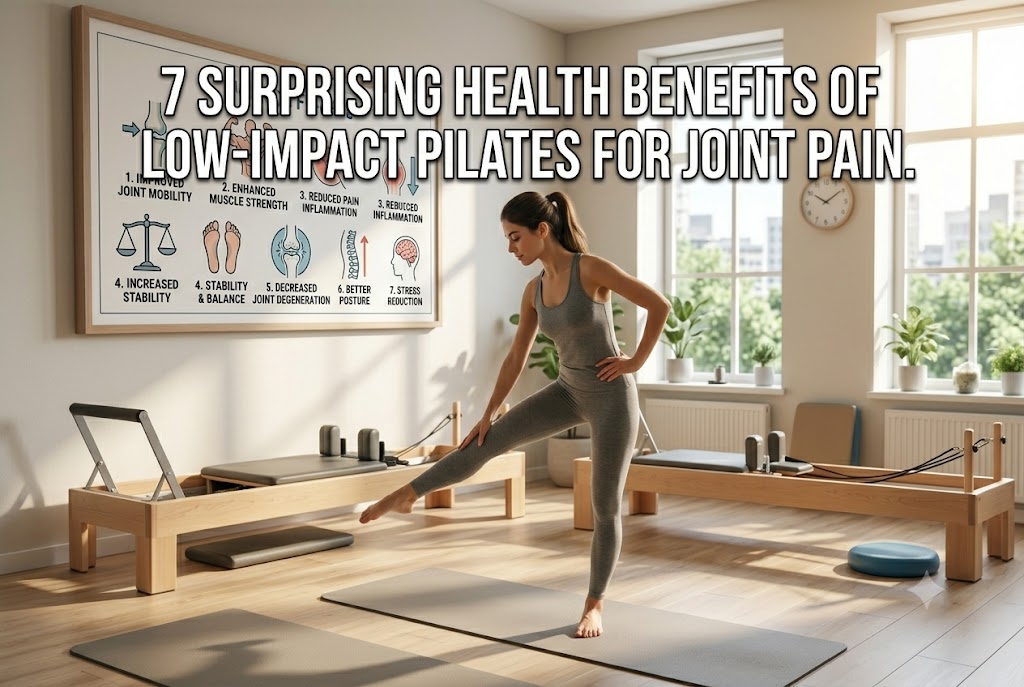
You can prevent this by practising low-impact Pilates, a low-movement exercise that strengthens the body without punishing it. There are several benefits of Pilates for joint health, and regular practice will help you build an athletic physique and soothe chronic physical pain.
We will discuss them and more in this article, but first, let’s see what makes this exercise different.
Why Low-Impact Pilates is Different
Low-impact Pilates was developed in the 20th century as a form of rehabilitation for injured soldiers and dancers. It is built on six core principles: centring, concentration, control, precision, breath, and flow. Unlike gym workouts that focus more on heavy weight lifting, Pilates focuses more on building strength from the inside out.
This makes it a low-impact exercise for arthritis and general joint wear-and-tear. Also, Pilates allows you to perform deep muscle conditioning without putting any vertical crushing pressure on your skeletal system.
Furthermore, low-impact Pilates targets the small, intrinsic stabilising muscles that wrap around your joints like a protective corset. When these stabilising muscles are strong, they take the heavy burden of gravity off your cartilage bones, allowing you to move through your daily life with better fluid freedom and agility.
7 Ways Low-Impact Pilates Restores and Protects Your Joints
If you practice Pilates regularly, it will alter, heal, and strengthen your body’s connective tissues in the following ways:
1. Increase Synovial Fluid Production to Lubricate Your Joints
You might not know this, but your joints do not have a direct blood supply. Instead, they rely on a clear, thick liquid called the synovial fluid to deliver nutrients and keep movement smooth.
When you practice pilates, it uses continuous, controlled, and fluid elongation movements to compress and release the joint capsule. The motion created during pilates acts like a pump, boosting the production of synovial fluid.
2. Correct Muscle Imbalances to Decompress Cartilage
Most joint pain is caused by uneven pulling. If one muscle group is overly tight and the opposing muscle is weak, your joint gets pulled completely out of alignment, causing the bone to rub painfully against cartilage.
One of the primary holistic benefits of Pilates is its focus on symmetry and balance. So, when you practice low-impact Pilates, it identifies and strengthens weak stabiliser muscles, and naturally returns your joints to their correct anatomical tracks.
3. Strengthen the Powerhouse Core to Protect the Lower Spine
In Pilates, your core is your “powerhouse,” and it includes your deep abdominals, lower back, pelvic floor, and glutes. When your powerhouse is weak, your lower back takes the brunt as you walk, leading to chronic lumbar pain.
Practising low-back pilates helps your body build deep functional core strength. Then this core strength creates a natural decompressive lift in your torso, taking the physical pressure off your spinal discs.
4. Lengthen Muscles to Improve Range of Motion
Do you know that traditional strength training causes muscles to shorten and bunch up?
This can restrict your movement and cause joint tightness. On the other hand, pilates emphasises eccentric muscle contractions, meaning the muscle is actively strengthening while being lengthened. As a result, your body builds long, lean, and highly flexible muscle fibres that will naturally increase your active range of motion without destabilising your ligaments.
5. Enhance Proprioception and Spatial Awareness
Proprioception is your brain’s ability to subconsciously perceive where your body is in space. People with poor proprioception are prone to clumsy movements, micro-misalignments, and accidental joint strain during everyday activities.
Low-impact Pilates requires intense mental concentration and precise movement control. As a result, it drastically sharpens your neuromuscular connection, helping you sit, stand, and move with safer and cleaner biomechanics.
6. Minimise Weight-Bearing Stress During Strength Building
Most Pilates exercises are performed while lying flat on a mat or using a specialised spring-resistance machine called a Reformer. The horizontal positioning is a significant win for Pilates for joint pain relief.
It allows you to challenge and strengthen your glutes. It also strengthens your hamstrings and quads without forcing your ankles, knees or lower spine to support your body’s full weight against gravity while moving.
7. Deactivate the Fight or Flight Pain Response
One thing about chronic joint pain is that it traps the body in a state of nervous stress, which increases your brain’s sensitivity to pain signals. Low-impact Pilates incorporates rhythmic, deep diaphragmatic breathing with every single exercise.
The breathwork stimulates the vagus nerve, activates your parasympathetic nervous system, lowers systemic cortisol, and effectively turns down the volume of chronic pain signals.
How to Start Pilates Safely When in Pain
To experience the true holistic benefits of Pilates without triggering a painful flare-up, you must be strategic, especially with the first sessions. We recommend doing the following:
- Avoid complex extensions or deep twisting until your core foundation is fully built. Focus entirely on the fundamental movements like the pelvic tilt, the chest lift, and leg circles.
- If your budget permits, take a few private sessions on a Pilates Reformer. The spring-loaded resistance can assist your movements, making it even easier on your joints than traditional mat work.
- Stop whenever you feel pain and give your body time to recover. Even if it is just a pinch, reduce your range of motion until you feel better.
Low-Impact Pilates Can Take You to a Pain-Free Future
Dealing with pain and healing your body does not require an aggressive, high-impact routine that leaves you hurting for days. By embracing a gentle, intelligent, and highly targeted set of principles of low-impact Pilates, you can heal your body and reclaim your physical autonomy. So, start small, start today, and you will reap the benefits in the long run.